Series of events – "Let's Talk about -TRANSFERS-"
From the winter semester of 2024 to the summer semester of 2026, we will be organising a participatory process as part of the ‘Let’s talk about -TRANSFER-’ series of events, with the aim of developing, as a community of practice, key structures for practical alliances and innovations.

Our Department of Applied Social Sciences at Hochschule München aims to strengthen the dynamic transfer between practice and theory in the applied social sciences by creating a new space for communication and interaction. Our Innovation HUB is designed to highlight and further intensify the transfers that are already taking place with social organisations and services.
The following key issues are addressed in interactive future workshops:
- How do practitioners and the target audience envisage successful transfers with universities and the academic community?
- Which formats are you familiar with and would you like to see? How should the HUB be designed accordingly?
- In what ways would practitioners, self-advocates and those for whom the initiative is intended like to, and be able to, get involved?
In addition, we will be taking a look at existing promising practices relating to transfers of knowledge in social organisations and educational institutions during a series of digital roundtables.
The successful launch of the series, which attracted over 100 participants in the 2024/2025 winter semester, demonstrates the potential of this initiative, which is being implemented in collaboration with HM:UniverCity. We look forward to your diverse contributions and expertise over the coming semesters as we work together to develop the concept for the Innovation HUB and establish sustainable partnerships.
Documentation and up-to-date dates
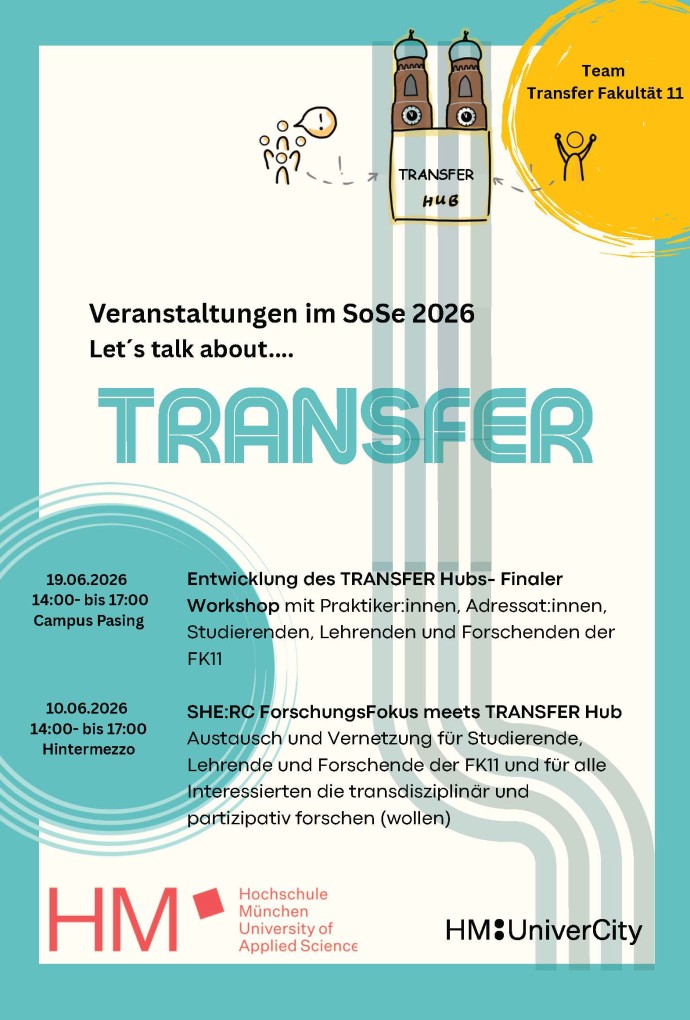
Upcoming events

Workshop I: Lecturers
First ‘Let’s talk about -transfers-’ workshop
with lecturers
As bridge-builders who are at home both at our university and in the professional world, the lecturers played a major part in ensuring a successful start to the series of events.
The workshop on 24 October 2024 brought together 15 lecturers, faculty members and Student Assistants to analyse existing challenges using the ‘Future Workshop’ format and to transform them into shared objectives.
The creative working phases led to practical ideas for the HUB, such as strengthening alumni engagement and implementing a participatory approach to identifying topics for regular, ongoing specialist days at the department.
Further information can be found in the documentation

Digital Roundtable I: Social Innovation Campus
First Digital Roundtable: ‘Let’s talk about transfers’
... with the Social Innovation Campus
The digital roundtable on 20 November 2024, featuring Professor Dr Lisa von der Heydte, highlighted the Social Innovation Campus at the KSH (Catholic Foundation University) in Munich as a best-practice example of successful knowledge transfers. The discussion focused on the challenges and opportunities of social entrepreneurship in the social economy and the ways in which these can be incorporated into the teaching of applied social sciences.
This event highlighted the need for a common language to facilitate collaboration. Social work and early years education can benefit from the dynamics and methodologies drawn from the fields of social innovation and social entrepreneurship.

Digital Roundtable II: Fachnetz Flucht
Second Digital Roundtable: ‘Let’s talk about transfers’
... with the ‘Fachnetz Flucht’ network
On 13 January 2025, the digital roundtable provided an insight into the ‘Fachnetz Flucht’ platform, facilitating an in-depth discussion on transfers and practical innovations in the social sector.
Prof. Dr Helen Landmann and Dr Jens Hellmann presented approaches to knowledge transfer that support social organisations and address practical challenges. The discussions highlighted the importance of civil society collaboration and outlined visions for asynchronous, hybrid formats designed to further bridge the gap between academia and practice. For example, the publication of brief academic responses to practical questions on the network’s website has proved very successful.

Workshop II: Practitioners
Second ‘Let’s talk about transfers’ workshop ...
... with practitioners
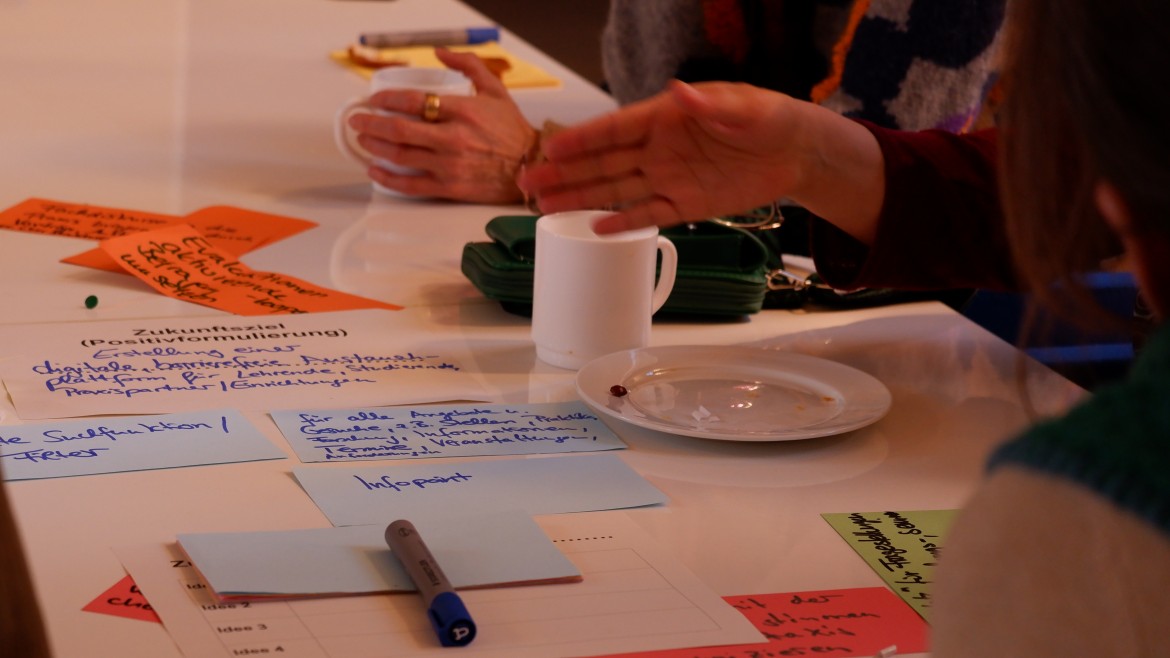
On 23 January 2025, a second interactive future workshop brought together around 60 experts and specialists from higher education and the social sector. Of particular note was the active participation of senior managers and practitioners, who provided valuable insights into the challenges and requirements for successful knowledge transfers.
Among other things, objectives such as more transparent integration structures, addressing practical questions through research, and closer cooperation in supporting students during their practical placements were identified. The focus was on the participatory development of ideas for innovative knowledge transfer formats for the future HUB, for example: a digital platform for the exchange of information, for specialist topics, for contact persons, and for an online careerportal run by the Department of Applied Social Sciences; a ‘role-swap’ programme for lecturers and professionals from the field; and the establishment of long-term, institutionalised partnerships with social organisations.
Further information can be found in the documentation
Digital Roundtable III: Child Protection Transfer Centre
Third Digital Roundtable: "Let's talk about transfers"...
...with the Child Protection and Children’s Rights Transfer Centre at the University of Rostock
Established in 2024, the Transfer Centre for Child Protection and Children’s Rights acts as an interface between academia, professional practice and society, and operates on the basis of a three-pillar model: research and teaching, innovative knowledge transfer formats, and participatory forums for dialogue.
The focus is on promoting comprehensive child protection based on children’s rights. The centre addresses specific issues and challenges encountered in practice and sees itself not only as an intermediary but also as an active participant: drawing on participatory knowledge-transfer formats, Maike Nadar and Anna Bahr develop specific modules for the academic community as well as application-oriented programmes – ranging from specialist conferences and workshops in ‘braver spaces’ to in-house training courses. Their success lies in a combination of networking, collaborations, the creation of accessible spaces for encounter and dialogue, and their own professional backgrounds as (former) social workers and social scientists with a local and national network.
Click here to visit the Child Protection & Children’s Rights Transfer Centre.
Workshop III: Target Audience
Third ‘Let’s talk about transfers’ workshop...
...and one-to-one discussions with female recipients – perspectives for teaching and transfers
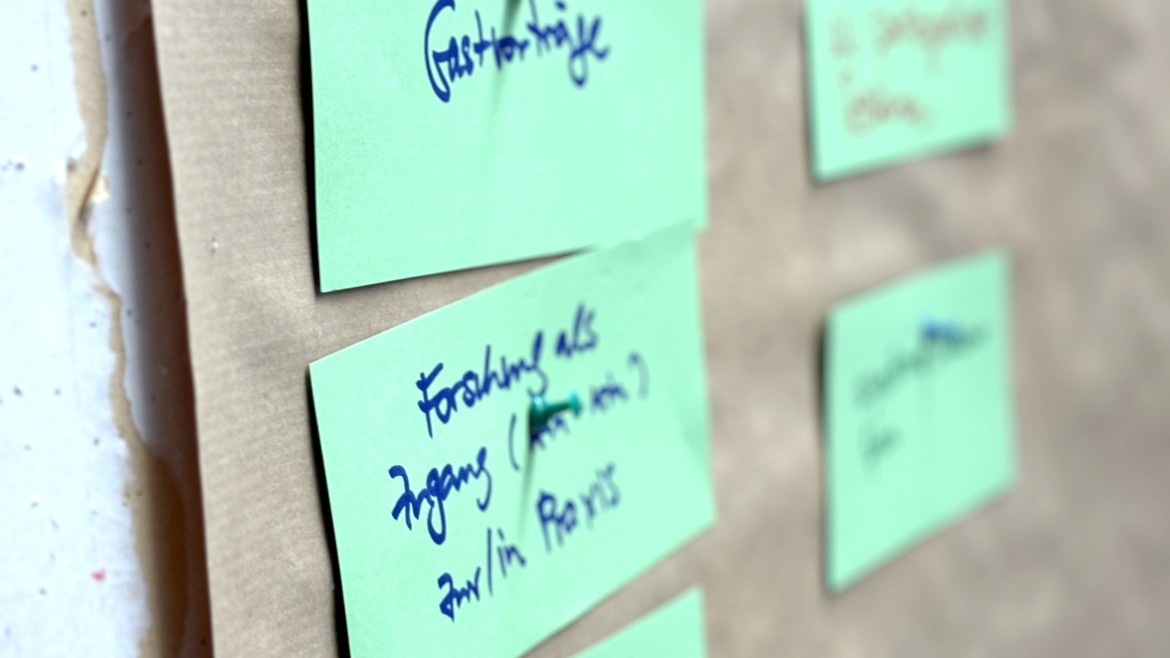
In April and May 2025, we held discussions with those involved in social work in order to incorporate their perspectives into the development of our knowledge transfer hub. The focus was on their own experiences, as well as their ideas and wishes regarding the training of social workers and their own potential involvement in teaching, research and knowledge transfer processes.
The discussions clearly demonstrated just how crucial it is to build relationships and trust over time, through humanity and openness. A rigid focus on rules, a lack of participation and power imbalances were critically scrutinised (and in some cases perceived as hurtful). At the same time, the participants reported how empowering the recognition of individuality, genuine participation and interaction on an equal footing can be. Among the first concrete suggestions for the training programme are: more biographical learning, tandem formats with peer mentors, role-plays, as well as low-threshold, authentic ways of connecting and interactions.
The discussions highlight how important it is for the target audience to be actively involved as experts on their own lived experiences. Participation should be made possible in practice and embedded in the system – both in teaching and in the collaboration between higher education institutions, the professional world and the target audience.
Workshop IV: Self-advocacy
Fourth ‘Let’s talk about transfers’ workshop…
…with self-advocacy and self-help organisations
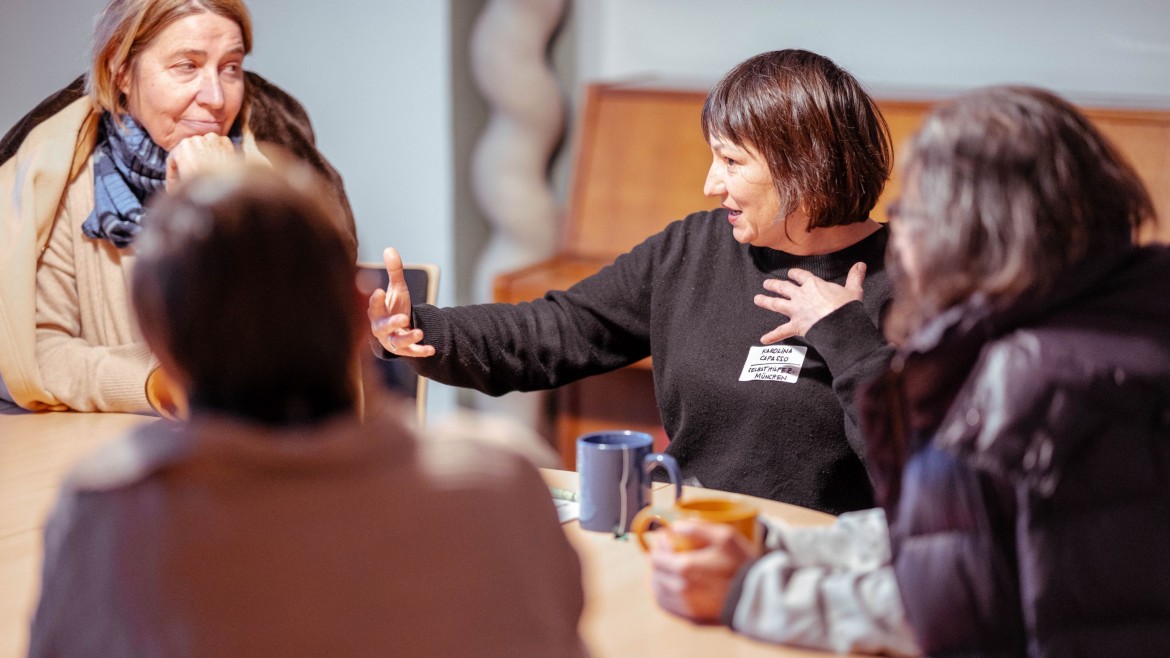
The fourth workshop in the ‘Let’s talk about TRANSFER’ series focused on the perspectives of self-advocacy groups and self-help organisations. Together, the participants identified key challenges and opportunities for teaching, knowledge transfers and participation.
It became clear that self-advocacy organisations, self-help groups and target groups are not sufficiently visible in teaching and learning. Expertise based on personal experience has, to date, been incorporated too rarely or not recognised as being of equal value. Greater attention should also be paid to students’ own biographical expertise.
Cooperation with self-advocacy groups and self-help organisations must be structurally embedded within the university. One idea in this regard was to involve them more closely in the development of curricula and course offerings. Other key issues included a lack of resources, bureaucratic hurdles and unpaid participation schemes, which make long-term commitment difficult.
The aim was set out as enabling students to draw on their personal experiences as a learning resource and to harness synergies between higher education, professional practice and self-advocacy – in the spirit of: ‘Talk to us, not about us’ – inspired by the motto of the Selbstvertretung wohnungsloser Menschen e.V. (Self-Advocacy Association for Homeless People).
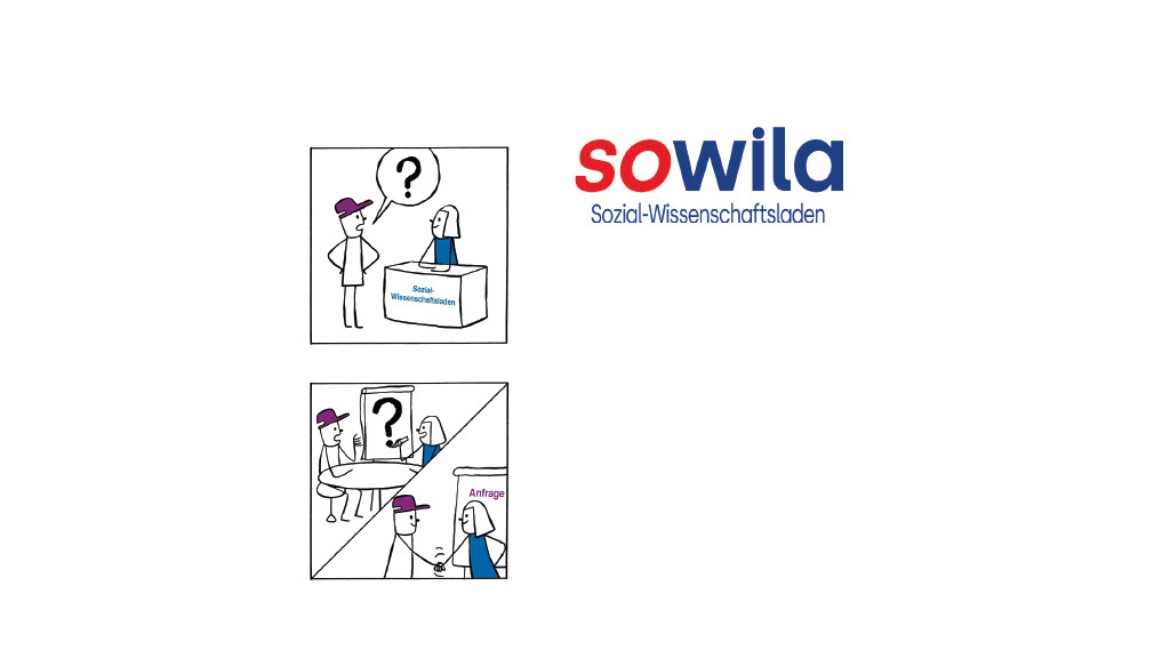
Digital Roundtable IV: Social Sciences Shop
Fourth Digital Roundtable: ‘Let’s talk about transfers’ …
…with the Social Sciences Centre at the Protestant University of Applied Sciences Bochum.
Participants from academia and the professional world discussed innovative ways of collaborating between target groups, practitioners and the university during a digital exchange with the Social Sciences Centre at the Protestant University of Applied Sciences Bochum.
The Social Sciences Centre shows how it’s done: teaching, participatory research and practice are consistently integrated here. Research projects are not carried out as externally funded initiatives, but as students’ final assignments and teaching-research projects. This supports committed students whilst addressing important social issues.
The focus is on the genuine participation of marginalised groups. Issues are developed in collaboration with the target audience. Cooperation agreements set out transparently who is involved in which phase of the project and in what capacity – the aim is to ensure transparency and reduce power imbalances right from the start.
What makes SoWiLa successful? Two permanent posts enable long-term, trusting relationships with self-advocacy groups and partners in the field. Each year, around 13–14 projects are supported, initiated by self-advocacy groups, lecturers, students or practitioners. The regular ‘SoWiLa Workshop’ brings all those involved together – including alumni. The project results are showcased in a variety of ways: as posters on the website, through specialist conferences, exhibitions and other creative formats. This lively exchange has impressively demonstrated how participatory research can be embedded in teaching and how this creates spaces for communication between the university, the professional world and society.
Final workshop
Final ‘Let’s talk about transfers’ workshop
… The closing event, featuring a diverse range of participants
“What if I woke up tomorrow and there was the ideal collaboration between higher education and the professional world?” On the afternoon of Friday 19 June 2026, around 50 members of the TRANSFER community came together to explore this question. Despite the summer heat, a remarkably large number of participants turned up, and the diversity of the group was particularly encouraging: representatives from self-help organisations, specialist organisations and professional bodies came together alongside students, lecturers and members of Department 11.
Following opening remarks by the Dean of Department 11 and the cooperation partner from HM:UniverCity, the Transfer Team provided a review of the “Let’s talk about TRANSFER” event series and the outcomes of the one-and-a-half-year process, as well as a presentation of the Transfer HUB model. This comprises a shared foundation – the development of a Transfer Community through networking, exchange and interaction – and three pillars: firstly, ‘Shaping good research and practice together’, with the aim of collaborating on research and practical innovation; secondly, ‘Shaping good education together’, for cooperation in teaching and practical placements; and thirdly, ‘Working together for a socially just society’, with a focus on social impact and advocacy.
Utopian thinking was explicitly encouraged during the first phase of the project in order to develop a shared vision amongst self-help groups, lecturers, students and practitioners. There was particular agreement that both the university and the professional sector should establish a collective voice in the form of a transdisciplinary alliance. Furthermore, the need to clearly define responsibilities and to have control over resources such as time and funding was emphasised. Regular communication and the presence of university representatives in professional organisations were also identified as key conditions for success.
This utopian brainstorming session was followed by the implementation phase. Using the ‘target cross’ method, five format ideas were prioritised and developed further from a total of 43 proposals generated during the process: ‘PraTa with Alumni Festival’, ‘Symposium at the end of 2028’, ‘Research Practice Partnerships’, ‘Incorporating biographical experiential knowledge into teaching’ and ‘Training for practice supervisors with certificates’. Initial considerations regarding objectives, target groups and possible implementation were made for these formats, which will serve as the basis for further elaboration.
The final workshop does not mark the end of the process. There are concrete plans to continue working on the ideas developed, and during the workshop itself, a number of participants volunteered to act as future points of contact for specific formats. The Transfer team will continue to guide and support this process. Further networking events are also planned to ensure that transfer formats are firmly established in higher education and professional practice in the long term.
First Digital Roundtable: ‘Let’s talk about transfers’ ...
... with the Social Innovation Campus
The digital roundtable on 20 November 2024, featuring Professor Dr Lisa von der Heydte, highlighted the Social Innovation Campus at the KSH (Catholic Foundation University) in Munich as a best-practice example of successful knowledge transfers. The discussion focused on the challenges and opportunities of social entrepreneurship in the social economy and the ways in which these can be incorporated into the teaching of applied social sciences. This event highlighted the need for a common language in such collaborations. Social work and early years education can benefit from the dynamics and methodologies drawn from the fields of social innovation and social entrepreneurship.
Click here to visit the Social Innovation Campus.
Second Digital Roundtable: ‘Let’s talk about transfers’ ...
... with the ‘Fachnetz Flucht’ network
On 13 January 2025, the digital roundtable provided an insight into the ‘Fachnetz Flucht’ platform, which facilitates in-depth discussion on knowledge transfer and practical innovations in the social sector. Prof. Dr. Helen Landmann and Dr. Jens Hellmann presented approaches to knowledge transfer that support social organisations and address practical challenges. The discussions highlighted the importance of civil society collaboration and outlined visions for asynchronous, hybrid formats designed to further bridge the gap between academia and practice. For example, the publication of brief academic responses to practical questions on the network’s website has proved very successful. Click
here to visit the Fachnetz Flucht website ...
Second ‘Let’s talk about transfers’ workshop ...
... with practitioners
On 23 January 2025, a second interactive future workshop brought together around 60 experts and specialists from higher education and the social sector. Of particular note was the active participation of senior managers and practitioners, who provided valuable insights into the challenges and requirements for successful transfers. Among other things, objectives such as more transparent integration structures, research addressing practical questions, and closer cooperation in supporting students during their practical placements were identified. The focus was on the participatory development of ideas for innovative knowledge transfer formats for the future HUB, for example: a digital platform for the exchange of information, for specialist topics, for contact persons, and for an online marketplace => the Department of Applied Social Sciences’ careers portal; a ‘role-swap’ programme for lecturers and professionals from the field; and the establishment of long-term, institutionalised partnerships with social organisations. Further information can be found in the documentation
Third Digital Roundtable: "Let's talk about transfers"...
...with the Child Protection and Children’s Rights Transfer Centre at the University of Rostock
Established in 2024, the Transfer Centre for Child Protection and Children’s Rights acts as an interface between academia, practice and society, and operates on the basis of a three-pillar model: research and teaching, innovative knowledge transfer formats, and participatory forums for dialogue.
The focus is on promoting comprehensive child protection based on children’s rights. The centre addresses specific issues and challenges encountered in practice and sees itself not only as an intermediary but also as an active participant: drawing on participatory knowledge-transfer formats, Maike Nadar and Anna Bahr develop specific modules for the academic community as well as application-oriented programmes – ranging from specialist conferences and workshops in ‘braver spaces’ to in-house training courses. Their success lies in a combination of networking, collaborations, the creation of accessible spaces for encounter and dialogue, and their own professional backgrounds as (former) social workers and social scientists with a local and national network.
Click here to visit the Child Protection & Children’s Rights Transfer Centre.